
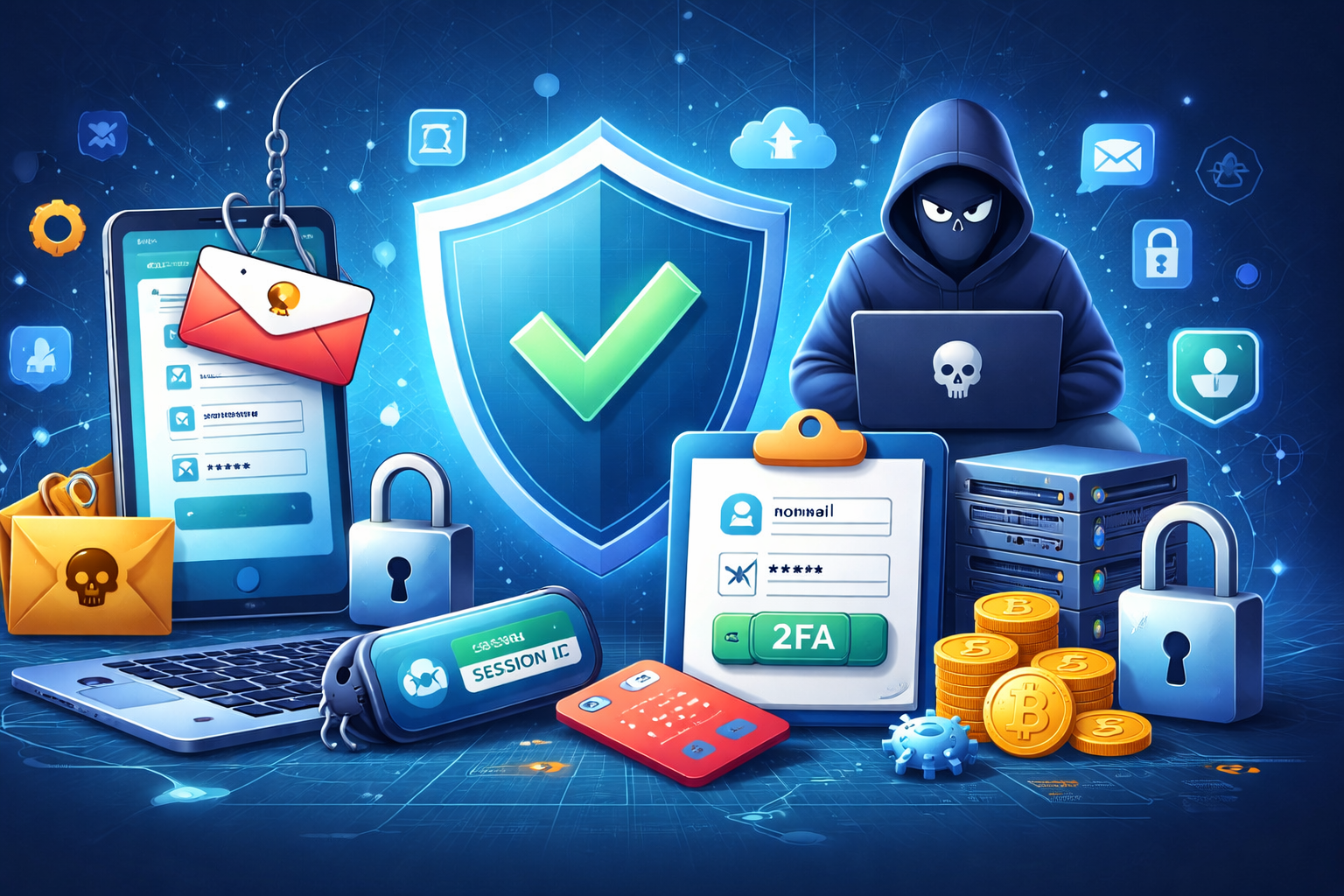
The rise of phishing-as-a-service and the battle to protect modern authentication systems.
In March 2026, law enforcement agencies and cybersecurity firms dismantled Tycoon 2FA — one of the largest phishing operations ever recorded, linked to over 64,000 attacks and breaches at nearly 100,000 organisations worldwide. Its weapon of choice: defeating multi-factor authentication itself.
Table of Contents
Why Tycoon 2FA Existed — and Thrived
Tycoon 2FA was a subscription-based platform that enabled threat actors to impersonate users, create phishing pages, and bypass multi-factor authentication. It allowed malicious hackers to intercept authentication sessions and gain access to targeted email and cloud accounts without triggering security alerts.
The platform’s longevity came down to one core design choice: it was built to be a business. The kit was sold via Telegram and Signal for as little as $120 for ten days, or $350 for monthly access to a full web-based administration panel. It came with customer support, pre-built brand templates, and a polished dashboard — lowering the barrier so that even technically unskilled criminals could launch sophisticated attacks.
The platform provided core phishing components on a single dashboard, allowing cybercriminals to configure, track, and refine their campaigns with ease. This commoditisation of cybercrime — where dangerous tools are packaged, sold, and supported like legitimate SaaS software — is precisely what
How It Worked — The Mechanics Behind Bypassing Your Security
Most people believe that enabling two-factor authentication on their accounts makes them near-invulnerable to phishing. Tycoon 2FA proved otherwise. The platform operated as an adversary-in-the-middle phishing system — a technique that intercepts communication between a victim and a legitimate service during the login process. When a user entered their credentials and responded to authentication prompts, the system relayed that information in real time to the actual service while simultaneously capturing passwords, authentication codes, and session cookies.
In plain terms: the attacker sits invisibly between you and your Microsoft 365 login. You think you’re logging in normally — but every keystroke and authentication code is handed to a criminal in real time.
Tycoon 2FA’s platform enabled threat actors to impersonate trusted brands by mimicking sign-in pages for services like Microsoft 365, OneDrive, Outlook, SharePoint, and Gmail. It also allowed attackers to establish persistence and access sensitive information even after passwords were reset, unless active sessions and tokens were explicitly revoked.
That last detail is chilling. Changing your password after a breach — the most common advice given — was not enough. The attacker’s stolen session cookie remained valid, meaning they stayed inside your account silently even as you thought you had locked the door.
Why It Matters — The Real-World Damage
The scale of harm was not abstract. Organisations in education and healthcare were hit hardest. In New York alone, two hospitals, six schools, and three universities confronted attempts or successful compromises via Tycoon 2FA, resulting in incidents that disrupted operations, diverted resources, and delayed patient care.
By mid-2025, Tycoon 2FA accounted for approximately 62% of all phishing attempts Microsoft blocked, including more than 30 million emails in a single month. That is not a niche criminal operation — that is a dominant force reshaping the threat landscape, one forged out of convenience, low cost, and global reach.
Phishing emails sent from the kit reached over 500,000 organisations each month worldwide, with campaigns indiscriminately targeting education, healthcare, finance, non-profits, and government. Nobody was off the target list.
What Must Change
The takedown was a victory — but not a permanent one. Platforms like Tycoon 2FA are part of a broader ecosystem in which new tools quickly emerge to replace those shut down. Sustained, coordinated public-private action must become the norm rather than the exception.
Switch to phishing-resistant MFA. Standard SMS codes and app-based one-time passwords are no longer sufficient against adversary-in-the-middle attacks. Hardware security keys (like YubiKey) or passkeys are far harder to intercept.
Revoke all active sessions after any suspected breach — not just change the password. Session tokens are now a primary target, and a password reset alone leaves the door open. Adopt email authentication standards. Organisations must implement DMARC, DKIM, and SPF to reduce the effectiveness of spoofed login pages reaching staff inboxes. Sustain coordinated public-private action. Disrupting one component of the cybercrime ecosystem can have cascading effects. The model set by this operation must be repeated at scale.
THE STRATEGIC OUTCOME
The action was carried out by law enforcement partners and private sector stakeholders working hand in hand, coordinated by Europol’s European Cybercrime Centre. As part of the disruption, 330 domains forming the core infrastructure of the criminal service — including phishing pages and control panels — were taken down. The alleged creator, Saad Fridi, has been named in a civil complaint demanding a $10 million injunction.
The Tycoon 2FA takedown is a landmark — not because it ends phishing, but because it proves that the cybercrime economy is not untouchable. When intelligence is shared across borders, and private companies act in coordinated legal and technical unison, the infrastructure criminals depend on can be dismantled. The question is whether the industry can move fast enough to do it again — before the next Tycoon 2FA is already in your inbox.
"By lowering the technical barrier to entry, it allowed criminals with limited expertise to run sophisticated impersonation campaigns. The fight back requires the same principle in reverse — lowering the barrier for defenders to act together."
Nice Post